
Transponder keys, smart keys, and push to start systems
Knowing which of these your vehicle uses answers most of the questions about cost and process before you ask them. It takes about thirty seconds to work out.
Or send a service request online if you cannot call right now.
Work out what you have in thirty seconds
-
How do you start it?
Insert and turn means a mechanical or transponder key. Press a button with the key in your pocket means a proximity smart key.
-
What does the key look like?
Plain metal means no chip. Thick plastic head with no buttons means a transponder. Buttons in the head means a remote head key. Folding blade means a flip key.
-
Does a blade slide out of the fob?
If yes, that is a smart key with an emergency blade. If there is no blade at all, it is a pure proximity key.
- CT registered locksmithRegistration LCK.0000486
- Insured locksmithWork done by an insured business
- Upfront quote and ETABefore anyone is dispatched
- Pay after the workOnly once the job is done
- Family ownedLocal and accountable
- Damage free entryOur standard method
The three technologies, in plain terms
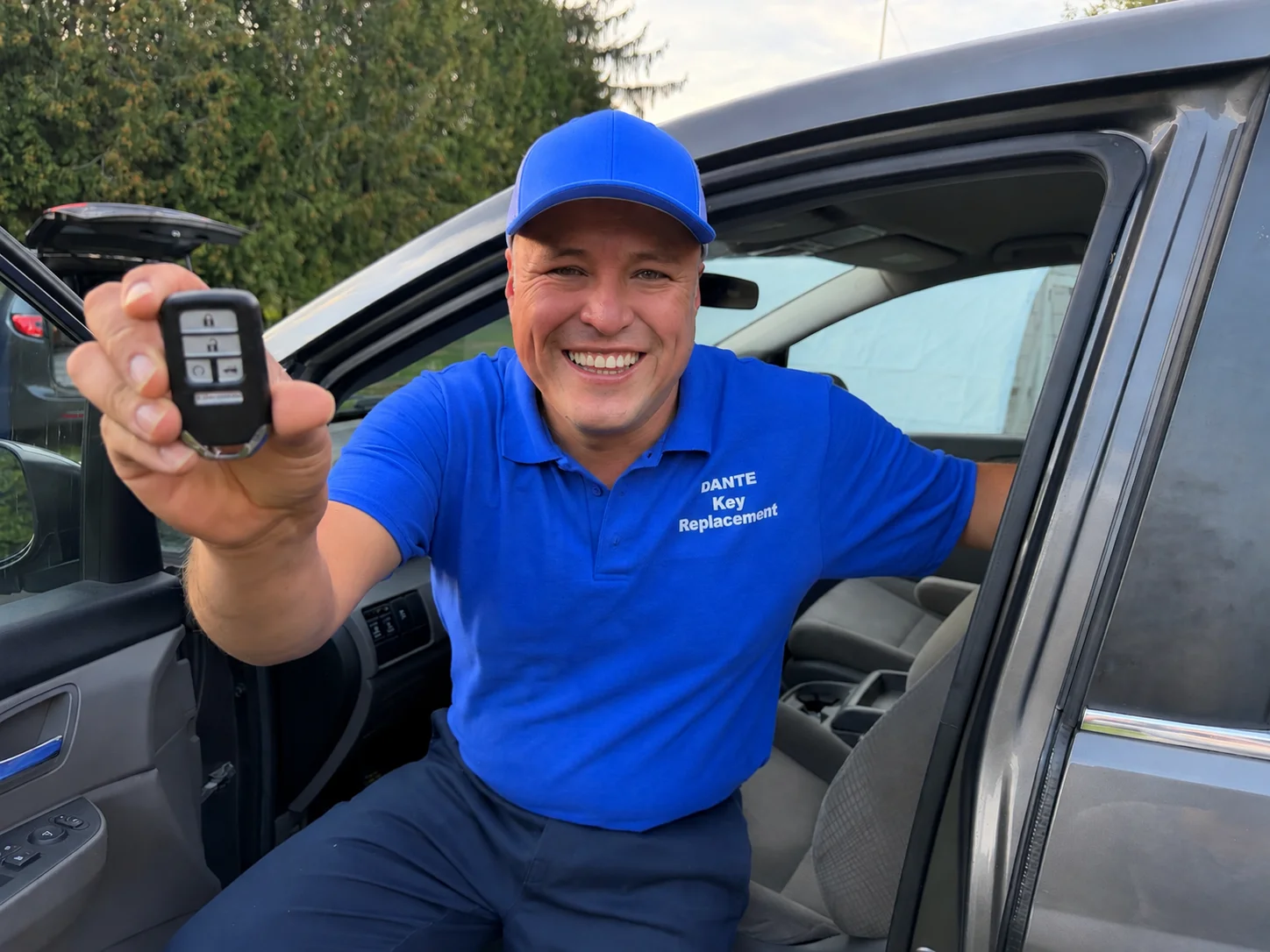
A transponder key has a passive chip in its head that answers a signal from the vehicle when the key is turned, and it has no battery of its own. A remote head or flip key adds battery powered buttons for locking and unlocking. A proximity smart key is detected by the vehicle without being inserted, and the engine starts at the press of a button. Replacement gets more involved and more expensive as you move down that list.
- Transponder chips never go flat. They are powered by the vehicle signal.
- Remotes and smart keys have batteries. A dead one is the most common fault.
- Smart keys are strictest to replace, particularly when every key is lost.
How the systems compare
Sort by any column. The last column is the one that decides what you will pay.
| Key type | Has a battery | How it starts the vehicle | Replacement complexity |
|---|---|---|---|
| Mechanical key | No | Insert and turn, no electronics involved | Lowest. Cutting only. |
| Transponder key | No, the chip is passive | Insert and turn, chip answers the immobilizer | Low to moderate. Cutting plus programming. |
| Remote head key | Yes, for the buttons | Insert and turn, buttons handle the locks | Moderate. Cutting, programming, and remote pairing. |
| Flip key | Yes, for the buttons | Flip out the blade, insert and turn | Moderate. Same as a remote head key. |
| Proximity smart key | Yes, and it is essential | Detected nearby, engine starts at a button | Highest. Stricter security process. |
What you get shown when your key is handed over
A new key is not just handed to you. These three things get pointed out at the vehicle, because knowing them turns a future bad evening into a minor inconvenience.
-
Where the hidden blade is
Most smart keys conceal a mechanical blade behind a small catch, and on some vehicles the door keyhole is hidden behind a cover on the handle. Both get pointed out on your own vehicle, in daylight, so you are not discovering it in a dark parking lot.
-
The backup start position for your model
Manufacturers build in a backup start method, and the location differs by model. Yours gets identified on your actual vehicle rather than left for you to find in a manual when it matters.
-
Which battery your fob takes
The exact cell number for your key, written down for you. A small thing, and it saves a guess in two years when the fob starts getting weak.
On relay attacks, honestly
Proximity systems have a known weakness where a signal from a key inside your home can be relayed to a vehicle on the driveway. The practical answer is simple and costs almost nothing: keep keys away from the front of the house, or use a signal blocking pouch. This is general security advice, not a product being sold here.
Have this ready before you request service
Every item below either speeds the job up or decides whether it can be done at all. Having them ready at the start avoids a second trip.
- The year, make, and model of the vehicle.
- Whether you have any working key or fob left.
- The exact location of the vehicle, including a lot, level, or row if it is in a garage.
- Registration or title in your name, plus a photo ID that matches it.
- Whether the vehicle is drivable and whether it is blocked in.
Why a spare matters most on a smart key vehicle
The gap between having one key and having none is widest on push to start vehicles.
- With one working key, adding a second is comparatively straightforward.
- With no key at all, the security process is at its strictest and its longest.
- Some manufacturers restrict all keys lost work on these vehicles to the dealer entirely.
What decides the cost of a transponder or smart key
-
Tell us about the job
The year, make, and model, whether any working key is left, and where the vehicle is parked.
-
Get your quote and ETA upfront
You hear the price for your exact vehicle or lock, and when to expect us, before anyone is dispatched.
-
Pay when the work is done
Nothing is paid up front. You pay once the job is finished and tested. Card, tap to pay, and cash are all accepted.
What changes the price
- Key type
- A basic mechanical key, a transponder key, a remote head key, and a proximity smart key are different parts with different costs.
- Programming needs
- Some vehicles accept a new key with on board programming. Others require a diagnostic tool and a security access process that takes longer.
- How many keys are lost
- Replacing a spare while you still hold a working key is a shorter job than an all keys lost situation, which needs the key cut from the vehicle code and the system reprogrammed.
- Vehicle security level
- Some manufacturers hold key data behind a secure gateway or a waiting period. That changes the time and the equipment required.
- Location and access
- A vehicle in an open driveway is quicker to work on than one in a tight garage bay or a lot that limits access.
Complete car key and vehicle lock solutions
Explore dedicated guides for every car key situation, key system, programming requirement, and vehicle make.
Car key replacement
Mobile cutting and programming at your vehicle.
Lost all keys
Keys generated from the vehicle when no spare exists.
Key fob replacement
Fob pairing, button diagnostics, and replacement remotes.
Transponder & smart keys Current
Chipped keys, proximity push to start, and smart fobs.
Car key programming
Immobilizer pairing, OBD-II tools, and online keys.
Spare & duplicate keys
Duplicate keys made before losing your only working key.
Ignition cylinder repair
Worn cylinders that will not turn, repaired at the vehicle.
Vehicle makes coverage
Key systems by manufacturer across 40+ brands.
Mobile dispatch across Eastern Connecticut
We travel directly to your location in Norwich, New London, Groton, Colchester, and all 48 service towns.
Transponder and smart key questions
A transponder key is a key with a small chip embedded in its plastic head. When you turn the ignition, the vehicle sends a signal, the chip answers with a code, and the engine is only allowed to start if the code is recognized.
There is no battery in the chip. It is powered by the signal from the vehicle, which is why a transponder key never goes flat. If your key has a thick plastic head and no buttons, it is very likely a transponder key.
A transponder key is physically inserted and turned. A smart key, also called a proximity key, stays in your pocket. The vehicle detects it nearby and you start the engine with a button.
The practical difference for replacement is that smart keys are usually more expensive and the security process for pairing them is stricter, particularly when every key has been lost.
Look at how you start it. If you insert a key and turn it, you have a mechanical or transponder key. If you press a button while the key stays in your pocket, you have a proximity smart key.
Then look at the key itself. Plain metal means no chip. A thick plastic head with no buttons means a transponder key. Buttons in the head means a remote head key. A blade that folds means a flip key. A fob with a blade that slides out, or no blade at all, means a smart key.
Not necessarily. A proximity key that is no longer detected can be a power problem, a synchronization problem, or a genuine failure, and on a push to start vehicle a dead car battery produces the same symptoms.
We identify which one it is at the vehicle before any part is replaced, so a replacement smart key is only supplied when it is actually the answer. These are the most expensive keys to replace, which is exactly why the diagnosis matters.
Two reasons. The hardware itself is more complex, containing a battery, a transmitter, and the security electronics rather than a passive chip. And the pairing process is stricter, because a proximity key can start a vehicle without ever being inserted.
That extra security is the point. It is also why an all keys lost situation on a push to start vehicle is the longest and most expensive version of this work.
Not through the key system itself, which is generally more secure than an older mechanical key. The known weakness is different: some proximity systems can be attacked by relaying the signal from a key sitting inside your home to the vehicle on the drive.
A practical response is to keep your keys away from the front of the house, and a signal blocking pouch is inexpensive if you want to remove the risk entirely. This is general security advice rather than a product this site sells.
Transponder and smart keys by vehicle
The brands this business is asked about most. Each page covers which key systems that brand uses and where a dealer may be required.
Send a photo of your key
A photo with the year, make, and model identifies your key faster than any description, and it means the right part is on the van the first time.
Or send a service request online if you cannot call right now.
Call or text with the vehicle or the property, the exact location, and what happened. You get an upfront quote and an arrival estimate before anyone is dispatched, and you pay only after the work is done.
Opening hours
HoursMonday to Friday 6:00am to 9:00pm, Saturday 6:00am to 11:00am
- Monday to Friday 6:00am to 9:00pm
- Saturday 6:00am to 11:00am
- Sunday Closed
Outside these hours, emergency jobs are taken case by case and are not guaranteed. Call to confirm.
Payment: Card, tap to pay, or cash, taken once the work is done.