

Rekey your locks and every old key stops working
Your locks stay on the door. The pins inside change, so a new key works and every key handed out before this stops working. It is the standard answer to a lost key or a house move.
Or send a service request online if you cannot call right now.
Count your cylinders, not your doors
This is what drives the price, and knowing it before you request service means the quote matches the job.
- Front door with a knob lock and a deadbolt. One door, two cylinders.
- Back door with one deadbolt. One door, one cylinder.
- Garage service door. Usually one cylinder, and frequently forgotten.
- Basement or side door. Also frequently forgotten, and it defeats the whole exercise if missed.
Walk around the outside of the property and count the keyholes. That number is your answer.
- CT registered locksmithRegistration LCK.0000486
- Insured locksmithWork done by an insured business
- Upfront quote and ETABefore anyone is dispatched
- Pay after the workOnly once the job is done
- Family ownedLocal and accountable
- Damage free entryOur standard method
What rekeying does
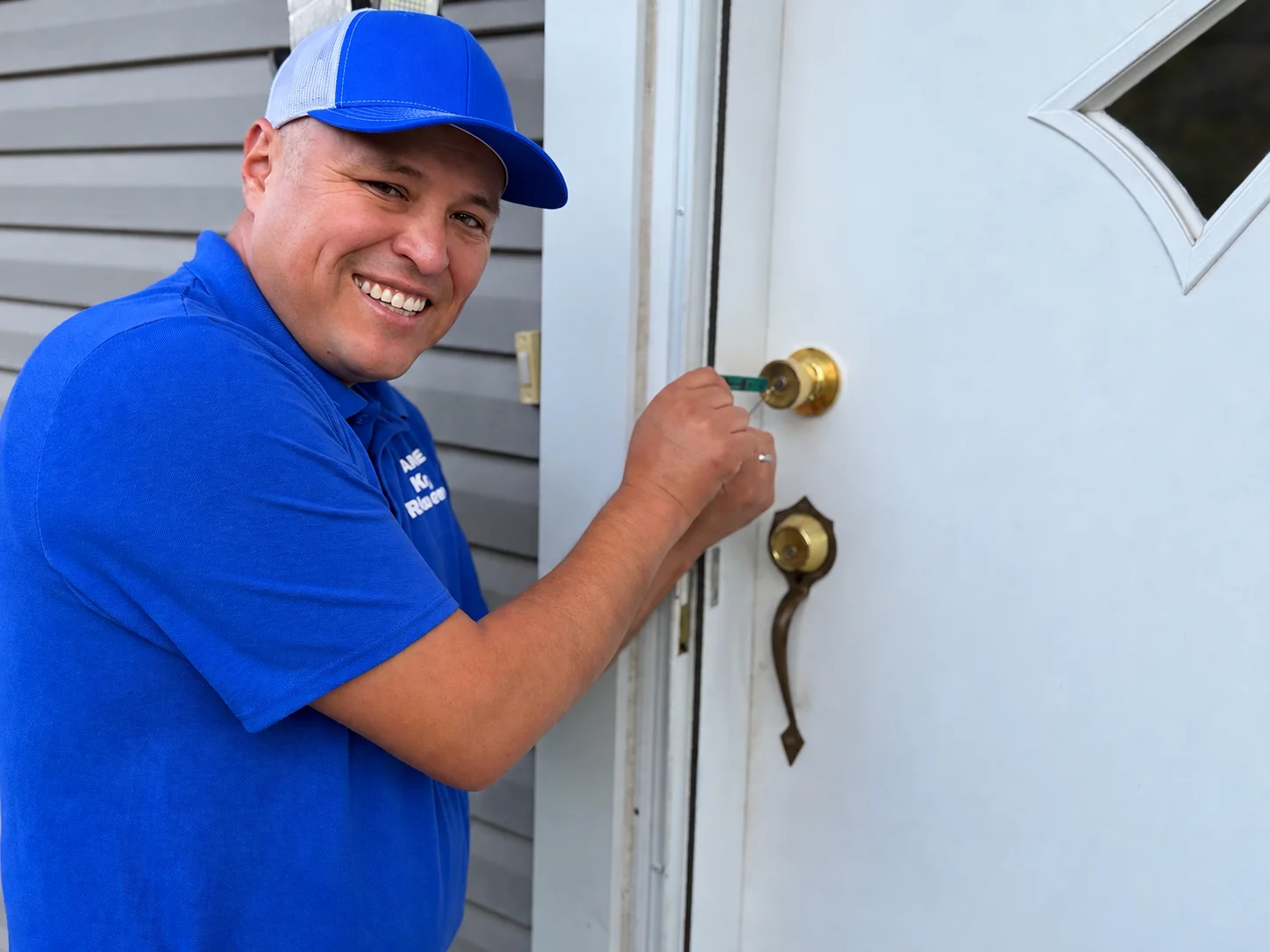
Rekeying changes the internal pins of your existing lock so that it works with a new key and no longer works with any previous key. The hardware stays on the door, so nothing is replaced and nothing changes visually. It is normally the least expensive way to make lost or unaccounted for keys useless, and it is the standard step after moving into a new home, losing a key, or a change of staff at a business.
- Price follows cylinders, not doors. Count the keyholes on your exterior doors.
- Everything can usually go onto one key. Ask for keyed alike when you request service.
- Replace instead of rekey when the hardware is worn, damaged, or obsolete.
The five situations that call for it
If any of these describes you, rekeying is almost certainly the right answer rather than replacing hardware.
You just moved in
You cannot know how many keys exist or who has one. Previous owners, relatives, contractors, cleaners, and neighbors holding a spare are all normal. Rekeying answers the whole question at once.
You lost a key
Particularly if it went missing with a bag or wallet containing your address. A key alone in a parking lot is low risk. A key with your address attached is not.
Someone left
A former tenant, a former employee, a former partner, or anyone whose access should have ended. Asking for a key back only works if you know how many exist.
You are carrying too many keys
Rekeying compatible cylinders to one key removes the daily annoyance of finding the right key in the dark. This is the reason people are happiest afterwards.
You had a break in or an attempt
If there is any chance a key was taken, or the lock was interfered with, rekeying restores control. Where the lock was damaged, replacement may be the better answer.
You inherited a property or took over a lease
Key history is usually unknown and undocumented in these situations. Rekeying gives you a clean starting point you can actually account for.
Which one do you actually need?
There is a straightforward test. Is the problem who holds a key, or is the problem the lock itself?
What rekeying changes inside the lock
Before. The old key lifts every pin exactly to the dashed line, so the lock turns.
After rekeying. New pins, same old key. The pins stop short of the line or push past it, so the lock stays shut.
- The locks work properly and turn smoothly.
- The problem is who might hold a key.
- You are happy with the hardware you have.
- You want several doors on one key.
- You want the lowest cost route.
- The lock sticks, grinds, or needs force to turn.
- It is damaged, or somebody has tried to force it.
- It is so old that parts are no longer available.
- The security grade is not right for the door.
- You want a different type, such as a keypad lock.
If you are unsure, describe how the lock feels when you use it. A lock that turns smoothly is a rekey candidate. A lock you have learned to be gentle with is telling you something, and the lock change page covers that case.
What happens during a rekey
-
The cylinders are counted and checked
Every exterior door is looked at, including the ones people forget: the garage service door, the basement door, and the side door. Missing one defeats the entire purpose.
-
Each cylinder is removed and opened
The lock comes off the door so the internal pin stack can be reached. Your hardware and its finish are unaffected.
-
The pins are changed to a new configuration
A new pin set matching a new key goes in. From this moment every previous key is mechanically incapable of turning that lock.
-
Everything is refitted and tested
Each cylinder goes back on its door and is tested with the new key before the job is closed. You try it yourself on every door.
Have this ready before you request service
Every item below either speeds the job up or decides whether it can be done at all. Having them ready at the start avoids a second trip.
- The full address, including a unit or an apartment number.
- Whether you own the property or rent it.
- Proof that you live there or own it, such as a lease, a deed, or mail with your name, plus a photo ID.
- Which door is locked and what type of lock it uses.
- Whether anyone else needs to approve the work, such as a landlord or a property manager.
Ask for keyed alike
One key for every exterior door is usually possible when the cylinders are compatible, and it is the change people notice most afterwards.
- One key on the ring instead of four.
- No fumbling for the right key in the dark.
- Easier to lend a single key to somebody you trust.
- Say so up front, because compatibility is checked in advance.
What decides the cost of rekeying
-
Tell us about the job
How many locks are involved, whether you want them rekeyed or replaced, and the brand on the lock if you can see one.
-
Get your quote and ETA upfront
You hear the price for your exact vehicle or lock, and when to expect us, before anyone is dispatched.
-
Pay when the work is done
Nothing is paid up front. You pay once the job is finished and tested. Card, tap to pay, and cash are all accepted.
What changes the price
- How many locks
- Rekeying four exterior cylinders costs more than rekeying one. The price scales with the number of cylinders, not the number of doors.
- Lock condition and brand
- A serviceable modern lock can usually be rekeyed. A worn, damaged, or obsolete lock is often cheaper to replace than to repair.
- Rekey against replace
- Rekeying keeps your existing hardware and changes which key operates it. Replacement changes the hardware itself. Rekeying is usually the lower cost option when the hardware is in good shape.
- Keyed alike requests
- Bringing several locks onto one key is straightforward when the cylinders are compatible and more involved when they are not.
- Access and hardware type
- A standard residential deadbolt is a different job from a commercial storefront lock.
Lockout, rekeying, and lock change services
Fast, damage free entry and lock services for vehicles, homes, and commercial properties across Eastern Connecticut.
Vehicle lockout
Damage-free door and trunk entry for cars, trucks, and RVs.
Home and apartment lockout
Non-destructive front door, knob, and deadbolt picking.
Commercial lockout
Office, storefront, and commercial door unlocking on site.
Rekey locks Current
Change internal pins so old keys no longer work.
Lock change and hardware
Fresh locksets, deadbolts, and hardware replacement.
Car key replacement
Lost your keys during a lockout? New keys made on site.
Rekeying questions
Rekeying changes the internal pins inside your existing lock so that it responds to a new key and no longer responds to the old one. The lock itself stays on the door. Nothing is removed, replaced, or visibly changed.
The result is that every key that was previously handed out stops working, while your hardware, your finish, and your door stay exactly as they are.
Usually yes, because you are not buying new hardware. You are paying for the work on cylinders you already own, and quality exterior locks are not cheap.
The saving grows with the number of doors. Rekeying four exterior cylinders is normally well below the cost of four new locks of comparable quality. Replacement only becomes the better value when the existing hardware is worn out, damaged, or not secure enough to be worth keeping.
Yes, and it is the single most commonly skipped security step in a house move. You cannot know how many keys exist. Previous owners, their relatives, a cleaner, a contractor, a dog walker, a neighbor holding a spare, and previous tenants may all have one.
None of those people are necessarily a threat. The point is that you have no way of knowing who holds a key to the place you now sleep, and rekeying resolves the entire question in one visit.
Usually, and it is called keyed alike. It is one of the most appreciated things a locksmith does, because carrying one key instead of four is a daily improvement rather than a one off fix.
It requires the cylinders to be compatible with each other, which is common but not universal, particularly if the locks were installed at different times or are different brands. Say up front that you want everything on one key so compatibility is checked before the visit rather than discovered during it.
By the number of cylinders, not the number of doors. This distinction saves people money and is worth understanding before you request anything.
A front door with a knob lock and a separate deadbolt is one door but two cylinders. A back door with a single deadbolt is one door and one cylinder. Count the keyholes on your exterior doors and you have the number that actually drives the price.
It depends on whether the key can be connected to your address. A key lost somewhere anonymous, with nothing on it identifying where you live, is a low risk. A key lost with a bag or a wallet containing your address is a very different situation, and so is a key lost by somebody who knows where you live.
If the key went missing along with anything showing your address, rekey. That combination is the one worth acting on rather than hoping about.
Rekeying in 48 Eastern Connecticut towns
Each town page explains what the local roads, housing, and access mean for the visit. Find yours below.
Hartford County 1 town
Middlesex County 4 towns
New London County 21 towns
Tell us how many cylinders you have
Walk around the outside and count the keyholes, including the garage and basement doors. Send that number and say whether you want everything on one key.
Or send a service request online if you cannot call right now.
Call or text with the vehicle or the property, the exact location, and what happened. You get an upfront quote and an arrival estimate before anyone is dispatched, and you pay only after the work is done.
Opening hours
HoursMonday to Friday 6:00am to 9:00pm, Saturday 6:00am to 11:00am
- Monday to Friday 6:00am to 9:00pm
- Saturday 6:00am to 11:00am
- Sunday Closed
Outside these hours, emergency jobs are taken case by case and are not guaranteed. Call to confirm.
Payment: Card, tap to pay, or cash, taken once the work is done.