

Spare keys, duplicates, broken keys, and ignition key problems
A spare made today costs a fraction of a key created after every key is gone. This is the one page on this site that is about spending a little now to avoid spending a lot later.
Or send a service request online if you cannot call right now.
Not sure what you need? Start here.
Answer in plain words. This points you to the right service in about ten seconds.
What are you locked out of, or what key is missing?
What happened with the vehicle?
- My keys are locked inside You can see them, you just cannot reach them
- Every key is lost No spare anywhere, nothing to copy from
- I have a key but the car will not start It turns, or the car sees it, but the engine will not start
- My fob buttons stopped working Locks and unlocks no longer respond
- I want a spare before something goes wrong I still have a working key
- My key broke Snapped, worn down, or stuck
What happened at the property?
You need a business lockout
Commercial doors use different hardware from a house, and authorization has to be checked before the door is opened. Have proof that you are entitled to access the premises ready.
- Say whether the door is glass framed or solid.
- Have proof of your authority to enter, such as a lease or business documents.
You need a vehicle lockout
This is entry only. No key is cut and nothing is programmed, so it is the simplest and quickest of the vehicle jobs.
- Have your registration or title plus a photo ID ready.
- Send the garage level and row, or the lot name, so the vehicle is found straight away.
You need all keys lost service
With no key left to copy, a new key is made from the vehicle itself and then programmed to the immobilizer. This is a longer job than a simple duplicate, and it needs proof of ownership without exception.
- Have the year, make, and model ready.
- Have your registration or title and a matching photo ID.
- Say whether the vehicle is drivable and where exactly it is parked.
You most likely need key programming or a key diagnosis
A key that turns but will not start the engine usually means the immobilizer is not recognizing it. That is a programming or transponder problem rather than a cut key problem.
- Say whether a security or immobilizer light is showing on the dash.
- Bring any spare key to the appointment, because it makes the diagnosis faster.
You may need a fob battery, reprogramming, or a replacement fob
Buttons that stopped responding are very often a dead coin cell battery rather than a failed fob. That is worth ruling out before anything is replaced.
- Say whether the fob does nothing at all or only works very close to the vehicle.
- Mention if the vehicle has been standing unused, because that changes the likely cause.
You need a spare or duplicate key
This is the cheapest time to solve a key problem, because a working key already exists to copy from. Once every key is gone the job becomes considerably more involved.
- Bring the working key so it can be copied and programmed.
- Have the year, make, and model ready.
You need broken key help and probably a replacement key
A key that snapped or wore down needs a new key made. If part of it is stuck in the lock or the ignition, say so clearly, because that changes what is involved.
- Say whether part of the key is still stuck in the lock or the ignition.
- Do not force the remaining piece, it can make the job harder.
You need a home or apartment lockout
The aim is entry without damaging your door or your lock. Proof that you live there is required before any door is opened.
- Have ID plus something linking you to the address, such as a lease or addressed mail.
- Say which door is locked and whether the deadbolt is thrown.
You should rekey your locks so the lost keys stop working
Lost keys are a security problem, not just an access problem. Rekeying keeps your existing hardware and makes every lost key stop working.
- Count your exterior cylinders, because price scales with cylinders and not doors.
- Decide whether you want everything on one key.
You should rekey the locks in your new home
You cannot know how many keys were handed out before you arrived. Rekeying is the standard first move in a new home and it is usually cheaper than replacing hardware.
- Include the garage entry door and any side or basement doors.
- Ask about bringing every exterior door onto one key.
You most likely need a lock change
When hardware is worn, damaged, or obsolete, replacing it is often the better value than repairing it. If the lock is still sound, rekeying may be all you need.
- Note the brand on the lock face if you can see one.
- Say whether the door itself sticks, because that can be the real problem.
Or send this as a service request
Would rather just talk to someone?
Skip the questions. A call sorts it in a minute.
- CT registered locksmithRegistration LCK.0000486
- Insured locksmithWork done by an insured business
- Upfront quote and ETABefore anyone is dispatched
- Pay after the workOnly once the job is done
- Family ownedLocal and accountable
- Damage free entryOur standard method
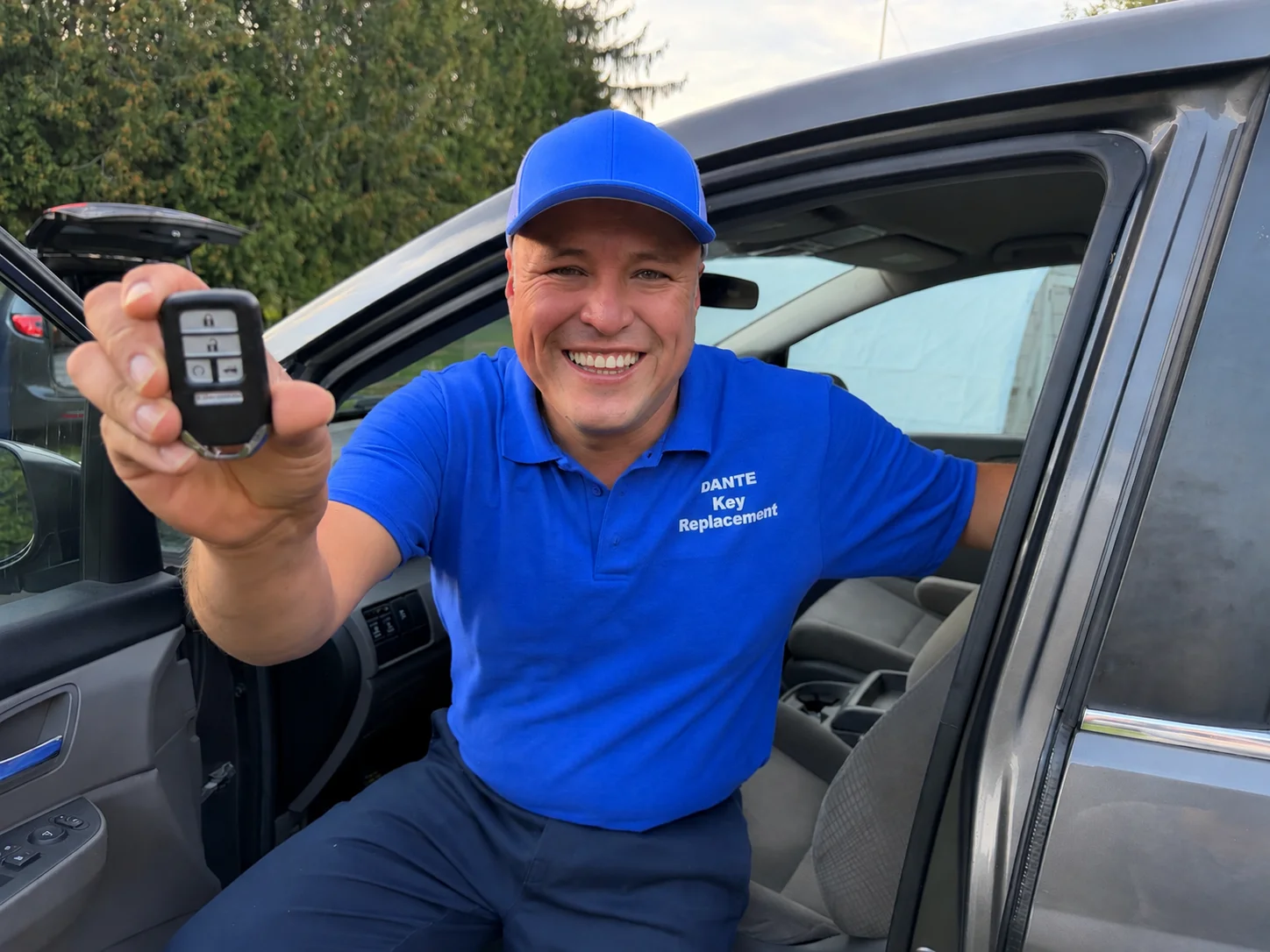
Why a spare key is the cheapest key decision
Copying a key while you still hold a working one is the least expensive version of car key service, because the existing key provides both the cut and, on many vehicles, the authorization to add another key. Once every key is lost, the cut has to be generated from the vehicle and the immobilizer has to be accessed without an accepted key present. That is why the same vehicle costs substantially more to key after the last key disappears.
- Two working keys, kept in different places. A spare in the same bag as the original solves nothing.
- The gap is widest on push to start vehicles. Those are the strictest to key from nothing.
- A worn key is a warning. Sticking or needing a wiggle means it is near the end.
- The cut is copied from your existing key.
- On many vehicles the working key authorizes adding another.
- No entry to the vehicle is required first.
- No security wait period on most vehicles.
- You choose the timing instead of the situation choosing it.
- The vehicle is never immobilized, so no tow is ever involved.
- The cut has to be generated from the vehicle itself.
- The immobilizer has to be accessed with no accepted key present.
- Entry to the vehicle may be needed first.
- Some manufacturers enforce a built in security wait period.
- It happens on the worst possible day, usually somewhere inconvenient.
- Some vehicles can only be done by a dealer, which adds a tow.
The best time to ask for a second key
If you are already having a key made after losing one, ask for a second during the same visit. The expensive part of that job is reaching the point where the vehicle accepts a key at all. Adding another once you are there is comparatively cheap, and it means you never repeat the process.
When a key snaps, stop before you make it worse
Most broken key jobs that turn into expensive lock replacements do so because of what happened in the ten minutes after the break.
Do this
- Leave the broken piece exactly where it is.
- Keep both halves, because they help identify the key.
- Note whether the piece moved or turned as it broke.
- Use another door or another key if you have one.
Do not do this
- Do not push the other half in to try to turn it.
- Do not use glue. This is the one that ruins cylinders.
- Do not force tweezers or a screwdriver into the cylinder.
- Do not keep trying the ignition once it has broken.
Ignition key problems
An ignition that will not turn is not always a key problem, and the difference matters because the jobs are priced very differently. The possibilities separate into a steering lock holding the cylinder, a worn key, a worn cylinder, or a fault in the ignition assembly itself.
Describing precisely what happens narrows it down before anyone drives out. Whether the key enters fully, whether it moves at all, and whether it had been working intermittently beforehand are the three details that identify the cause and decide what needs to be on the van.
Have this ready before you request service
Every item below either speeds the job up or decides whether it can be done at all. Having them ready at the start avoids a second trip.
- The year, make, and model of the vehicle.
- Whether you have any working key or fob left.
- The exact location of the vehicle, including a lot, level, or row if it is in a garage.
- Registration or title in your name, plus a photo ID that matches it.
- Whether the vehicle is drivable and whether it is blocked in.
Signs your key is about to fail
Keys give warning before they break. These are the signals worth acting on while it is still a cheap problem.
- It needs wiggling or jiggling to turn.
- The teeth look visibly rounded compared with a spare.
- It sticks on the way in or on the way out.
- It has a visible bend, or you have straightened it before.
- One door works and another has stopped.
If a spare exists and it works better than your daily key, that is the wear talking.
What decides the cost of a spare or a broken key job
-
Tell us about the job
The year, make, and model, whether any working key is left, and where the vehicle is parked.
-
Get your quote and ETA upfront
You hear the price for your exact vehicle or lock, and when to expect us, before anyone is dispatched.
-
Pay when the work is done
Nothing is paid up front. You pay once the job is finished and tested. Card, tap to pay, and cash are all accepted.
What changes the price
- Key type
- A basic mechanical key, a transponder key, a remote head key, and a proximity smart key are different parts with different costs.
- Programming needs
- Some vehicles accept a new key with on board programming. Others require a diagnostic tool and a security access process that takes longer.
- How many keys are lost
- Replacing a spare while you still hold a working key is a shorter job than an all keys lost situation, which needs the key cut from the vehicle code and the system reprogrammed.
- Vehicle security level
- Some manufacturers hold key data behind a secure gateway or a waiting period. That changes the time and the equipment required.
- Location and access
- A vehicle in an open driveway is quicker to work on than one in a tight garage bay or a lot that limits access.
Complete car key and vehicle lock solutions
Explore dedicated guides for every car key situation, key system, programming requirement, and vehicle make.
Car key replacement
Mobile cutting and programming at your vehicle.
Lost all keys
Keys generated from the vehicle when no spare exists.
Key fob replacement
Fob pairing, button diagnostics, and replacement remotes.
Transponder & smart keys
Chipped keys, proximity push to start, and smart fobs.
Car key programming
Immobilizer pairing, OBD-II tools, and online keys.
Spare & duplicate keys Current
Duplicate keys made before losing your only working key.
Ignition cylinder repair
Worn cylinders that will not turn, repaired at the vehicle.
Vehicle makes coverage
Key systems by manufacturer across 40+ brands.
Mobile dispatch across Eastern Connecticut
We travel directly to your location in Norwich, New London, Groton, Colchester, and all 48 service towns.
Spare key and broken key questions
Financially it is one of the clearest decisions in this trade. Copying a key while you still hold a working one is the cheapest version of this service. Creating a key when every key is gone is the most expensive.
The gap is not small, and it is widest on push to start vehicles. A spare also removes the towing question entirely, because a vehicle with a spare key can always be driven.
For a plain mechanical key with no chip, yes, and it is the cheapest route. That covers many older vehicles and it is a perfectly sensible thing to do.
For anything with a chip it will not be enough. The blade will turn the door and the ignition and the engine will not start, because the immobilizer does not recognize an unprogrammed chip. A copied blade is half the job on any vehicle built since the late 1990s.
Stop trying to remove it. Forcing a broken piece deeper, or trying to hook it out with something rigid, is what turns a straightforward extraction into a lock or ignition replacement.
Leave it where it is, do not insert the other half, and describe exactly what happened when you request service. Say which lock it is in, how much is showing, and whether the piece moved when it broke.
Usually wear rather than a single bad moment. Keys and lock cylinders wear together over years, and a key that had started sticking, needing a wiggle, or requiring pressure to turn was already telling you it was near the end.
Worth knowing: if you copy a worn key, you copy the wear. A duplicate made from a badly worn original inherits its problems, which is why cutting a fresh key to the vehicle code sometimes works better than copying what you have.
At least two working keys in total is the practical answer, kept in different places. A spare in the same bag as the original solves nothing when the bag is what goes missing.
If more than one person drives the vehicle, one working key each plus a spare kept at home is the arrangement that avoids the most problems.
An ignition that will not turn has several possible causes, and they are genuinely different jobs at different prices. A steering lock holding the cylinder, a worn key, a worn cylinder, and a fault in the ignition assembly all feel similar from the driver seat.
Describe exactly what happens when you turn it and you get a straight answer about which one it is likely to be, and whether it is something we handle, before anyone drives out.
Spare and replacement keys by vehicle
The brands this business is asked about most. Each page covers which key systems that brand uses and where a dealer may be required.
Get a spare while it is still the cheap option
Send the year, make, and model, and say that you still have a working key. That is the shortest and least expensive version of this job.
Or send a service request online if you cannot call right now.
Call or text with the vehicle or the property, the exact location, and what happened. You get an upfront quote and an arrival estimate before anyone is dispatched, and you pay only after the work is done.
Opening hours
HoursMonday to Friday 6:00am to 9:00pm, Saturday 6:00am to 11:00am
- Monday to Friday 6:00am to 9:00pm
- Saturday 6:00am to 11:00am
- Sunday Closed
Outside these hours, emergency jobs are taken case by case and are not guaranteed. Call to confirm.
Payment: Card, tap to pay, or cash, taken once the work is done.